
Breakfast & Brunch
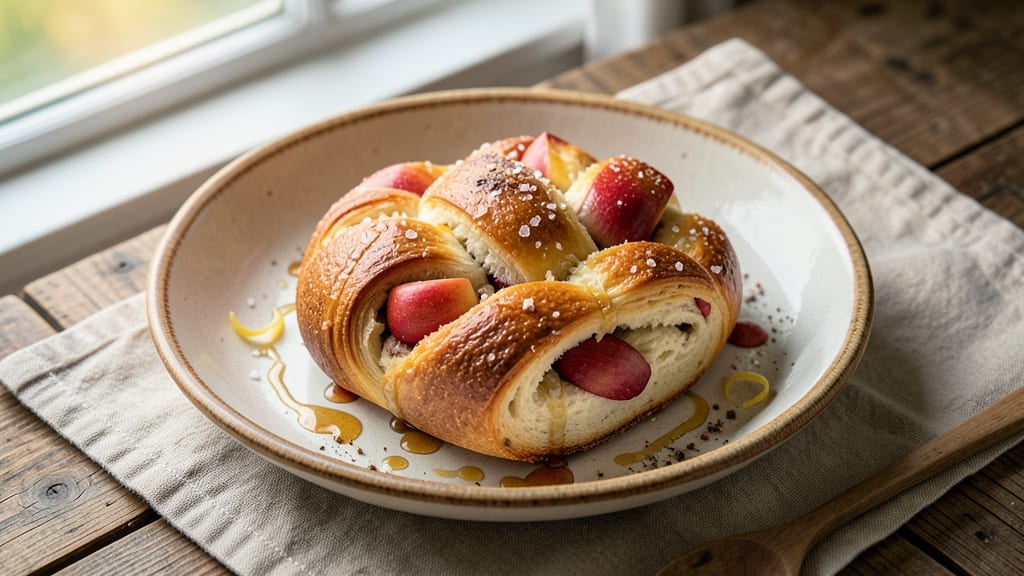
This apple braided bread recipe transforms fall harvest flavors into a showstopping centerpiece—crispy Dutch oven crust meeting tender, honeyed apple streusel swirls. The secret lies in a yeast-based dough that captures autumn's warmth while modern techniques make shaping and proofing foolproof.
I've perfected this version after years of baking competitions, where judges consistently called it "the most impressive loaf on the table."
The magic begins with a simple yeast dough enriched with apples—peeled, diced, and baked into streusel for natural sweetness. Braiding creates that iconic, rustic presentation while ensuring even baking. A Dutch oven delivers that coveted crispy bottom crust, while an egg wash gives the top a golden sheen.
The honeyed streusel swirls caramelize beautifully, adding texture and depth with every bite.
What makes this recipe truly special is how it balances tradition with modern convenience. While the braiding technique stays true to classic European styles, the 30-minute prep and one-hour bake time make it perfect for weekend baking.
The result? A loaf so visually stunning and flavor-packed that it becomes the star of any brunch or holiday gathering.
Serve warm with butter, jam, or as a side to soups—this bread is equally at home on a farmhouse table or a city apartment counter. The recipe includes tips for adjusting sweetness levels and troubleshooting common braiding challenges. Let's create something that looks as impressive as it tastes.
Ingredients for apple braided bread
Transform fall's harvest into a golden, braided masterpiece with these precise ingredients—each playing a key role in texture and flavor.
| Ingredient | Amount | Notes |
|---|---|---|
| All-Purpose Flour 🌾 | 4 cups | Sifted for light texture |
| Active Dry Yeast 🍞 | 2 ¼ tsp | Fresh or 1 packet |
| Granulated Sugar 🍚 | ¼ cup | For yeast activation |
| Unsalted Butter 🧈 | ½ cup | Cold, cubed for streusel |
| Large Eggs 🥚 | 1 whole | Room temperature |
| Whole Milk 🥛 | ½ cup | Warm for yeast activation |
| Salt 🧂 | 1 ½ tsp | Diamond Crystal preferred |
| Honey 🍯 | ¼ cup | Wildflower preferred |
| Apples 🍎 | 2 medium | Peeled, diced (Honeycrisp ideal) |
| Brown Sugar 🍚 | ¼ cup | Packed for streusel |
| Ground Cinnamon 🌿 | 1 tsp | Freshly ground preferred |
| Vanilla Extract 💧 | 1 tsp | Pure vanilla bean |
| Large Egg 🥚 | 1 whole | For egg wash |
| Coarse Sugar 🍚 | 2 tbsp | For topping |
The apples are non-negotiable for that signature caramelized sweetness. Honeycrisp or Fuji varieties hold their shape best during baking, but Granny Smith adds tart contrast. Peel and dice them uniformly—1/4-inch pieces work perfectly. For the flour, King Arthur or Gold Medal brands yield the best rise, though any all-purpose will do. The yeast must be fresh: if your packet is more than a few months old, test it first in warm milk to confirm activity. The Dutch oven isn't just for crust—it traps steam for that iconic tender crumb. Le Creuset or Lodge brands conduct heat evenly, but any heavy pot with a lid works.
No honey? Maple syrup at equal measure works beautifully, though the flavor profile shifts slightly. Substituting apples? Pear or quince hold up well, but texture changes dramatically. For the streusel, cold butter is crucial—it prevents overmixing and creates those signature crumbly pockets. Short on vanilla? Almond extract at half strength mimics the depth. The egg wash can be skipped if you prefer a matte finish, but a light brush of milk still adds sheen. For dietary flexibility, replace honey with agave nectar, though it lacks the same floral notes. Always weigh your flour if possible—spooning creates inconsistent volumes.
Store the dough in the fridge overnight for deeper flavor development—up to 24 hours works perfectly. Once baked, let the loaf cool completely before slicing to prevent gumminess. Wrapped in a beeswax wrap, it stays fresh for 3 days at room temperature or 3 months frozen. For reheating, wrap slices in foil and warm in a 300°F oven for 5 minutes. The streusel topping freezes beautifully—make extras for future quick breakfasts. To revive stale bread, spritz with water and bake at 350°F for 10 minutes
Why You'll Love This Recipe
- No-Knead Magic: I swear by this dough—just mix, rest, and braid. The yeast does all the work while you sip coffee, and the butter-rich dough stretches like a dream. No stand mixer? No problem.
- Sweet Spice Rush: That caramelized apple filling—warm cinnamon, a hint of nutmeg—turns every bite into comfort. The buttery crust seals in the flavor so it stays rich even hours later. (Yes, even on a Tuesday night.)
- Weekend Crowd-Pleaser: Perfect for brunch, potlucks, or just because. Slice it thick for breakfast toast or thin for sandwiches—my kids fight over the leftovers, and honestly, who am I to stop them?
- Budget-Friendly Staple: Uses pantry basics (flour, sugar, butter) that stretch far. A single batch feeds six, and the dough keeps for days in the fridge. I’ve made this for $3 a loaf—ridiculously good for the price.
Step-by-step instructions for apple braided bread
Here's the method for crafting a golden Dutch oven crust with sweet apple streusel swirls.
Activate the Yeast and Prepare the Dough
In a small bowl, whisk together the 0.5 cup warm whole milk, 0.25 cup granulated sugar, and 2.25 tsp active dry yeast until fully dissolved. Let it sit for 5-10 minutes until foamy—this confirms the yeast is active. If it doesn't foam, your yeast may be dead, and you'll need to start over.
In the bowl of a stand mixer fitted with the dough hook, combine the 4 cups all-purpose flour, 1.5 tsp salt, and 1 tsp ground cinnamon. Mix on low speed until evenly distributed. Add the yeast mixture, 1 whole large egg, and 1 tsp vanilla extract, then mix on medium speed for 5 minutes until the dough begins to pull away from the sides of the bowl. The dough should be soft but not sticky—if it's too wet, add 1 tablespoon flour at a time until it reaches the right consistency.
Prepare the Apple Streusel Filling
While the dough mixes, peel and dice the 2 medium apples into ¼-inch pieces. In a small bowl, combine the diced apples with 0.25 cup honey, 0.25 cup brown sugar, and 1 tsp vanilla extract. Set aside while you continue with the dough. The apples will release their juices, so don't worry if the mixture looks soupy—this is normal and adds moisture to the filling.
In a separate bowl, cut the 0.5 cup unsalted butter into small cubes. In the same bowl, mix the butter with 0.25 cup brown sugar and 1 tsp ground cinnamon using a fork or your fingers until the mixture resembles coarse crumbs. This will be your streusel topping, and its texture is key for that perfect crunchy-sweet contrast.
Shape the Dough and Add the Filling
Turn the dough out onto a lightly floured surface and knead it gently for 2-3 minutes to smooth it out. Roll the dough into a 12x18-inch rectangle about ¼-inch thick. Spread the apple mixture evenly over the dough, leaving a ½-inch border around the edges. Sprinkle the streusel mixture evenly over the apples, pressing down lightly to help it adhere.
Roll the dough tightly into a log, starting from one of the long sides. Pinch the seam to seal it, then gently twist the log into a braid by dividing it into three equal sections. Bring the left and right sections over the center section, alternating as you go to create the classic braided pattern. This step requires patience—don't rush it, or the braid will look uneven.
Proof and Shape for the Dutch Oven
Place the braided loaf on a parchment-lined baking sheet, seam-side down. Cover it loosely with a clean kitchen towel and let it proof in a warm place for 1-1.5 hours until it has nearly doubled in size. The dough should feel springy when pressed gently with your finger—this is the perfect proof. If the dough doesn't rise much, it may need more time, especially if your kitchen is cool.
Preheat your oven to 450°F and place a Dutch oven with its lid on the middle rack to heat as well. Once the dough has proofed, carefully transfer it to the hot Dutch oven. Brush the top with the 1 whole large egg beaten with a splash of water, then sprinkle evenly with the 2 tbsp coarse sugar. This creates a beautiful caramelized crust and adds a touch of sweetness to the top.
Bake to Golden Perfection
Cover the Dutch oven with its lid and bake for 30 minutes. Remove the lid and bake for an additional 15-20 minutes until the bread is deeply golden brown and sounds hollow when tapped on the bottom. The internal temperature should reach 190-200°F when measured with an instant-read thermometer. If the top browns too quickly, tent it loosely with foil to prevent over-browning.
Let the bread cool in the Dutch oven for 10 minutes before transferring it to a wire rack. The residual heat will help set the crumb, and the Dutch oven's trapped steam ensures a soft, tender interior. Once cooled, slice into 4 even portions and serve warm. The combination of the crispy Dutch oven crust, sweet apple filling, and buttery streusel makes every bite worth the effort.
Pro Tips For Making Apple Braided Bread
- Proof at 78°F: DESCRIPTION: Your yeast won’t wake up reliably if your kitchen’s too cold or too warm. Use an instant-read thermometer to check—78°F is the sweet spot for proofing apple braided bread dough. I learned this the hard way when my dough took three hours to rise in a chilly basement, and the apples ended up mushy from overproofing.
- Toss Apples in Lemon Juice: DESCRIPTION: Slice your apples and immediately toss them in 1 tablespoon of lemon juice. This stops oxidation and keeps them from turning brown while you prep the dough—no one wants a braid with dull, sad-looking fruit. (Yes, even if you’re impatient like me.)
- Shape Tight, Not Loose: DESCRIPTION: Pull the dough strands firmly when braiding—no slack. A loose braid will unravel in the oven, and your apples will sink instead of staying on top. My first attempt looked like a tangled mess, but after practicing, the braid held its shape and baked up beautifully.
- Brush with Egg Wash Twice: DESCRIPTION: After shaping, brush the braid with egg wash once, then let it rest 10 minutes before a second coat. The first layer sets up for a better crust, while the second adds shine. I skipped the second coat once and ended up with a dull, dry top—don’t make that mistake.
Serving suggestions for this apple braided bread
Brunch Showstopper
Serve warm slices of this apple braided bread alongside a creamy ricotta spread mixed with honey and chopped walnuts for a perfect balance of textures. The sweet-tart apples and buttery streusel complement the creamy ricotta beautifully.
I like to arrange slices on a wooden board with fresh berries for a rustic, inviting presentation. 🍓
Coffee Pairing
A strong brew of dark roast coffee cuts through the richness of the bread beautifully. For an extra treat, drizzle a little maple syrup over the top of your coffee and serve with a slice of warm bread.
If you prefer tea, a spiced chai with cinnamon and cardamom enhances the apple and cinnamon flavors in the bread.
Holiday Centerpiece
This bread makes an impressive centerpiece for holiday gatherings. Arrange slices on a platter with whipped cream and caramelized apples for a festive touch. For a more elegant presentation, dust the bread with powdered sugar and garnish with cinnamon sticks.
It pairs wonderfully with cheese boards featuring sharp cheddar and brie.
Make-Ahead Serving
Bake the bread a day ahead and store it in an airtight container at room temperature. Reheat slices in a 350°F oven for 5-7 minutes until warm and fragrant.
This makes it perfect for busy mornings or last-minute gatherings. Serve with a side of spiced apple butter for dipping—it’s a crowd-pleaser every time. 🍏
Dessert Twist
For a dessert version, serve slices with vanilla ice cream and a drizzle of warm caramel sauce. The contrast of warm bread and cold ice cream is pure indulgence.
You can also turn it into French toast by slicing the bread thin and cooking it in butter with cinnamon and sugar. Trust me, it’s a game-changer for breakfast or dessert. 🍦
Nutrition facts
Frequently asked questions
Can I make this apple braided bread without a Dutch oven?
Yes! If you don't have a Dutch oven, use a heavy baking sheet or cast-iron skillet. For best results, place it on the lower oven rack to create a crispy bottom crust. The bread will still turn out delicious, though the texture may be slightly less tender. You can also bake it in a regular loaf pan if you prefer a different shape.
How do I know when the dough has proofed enough?
The dough is ready when it's nearly doubled in size and feels springy when pressed gently with your finger. If it springs back slowly, it needs more time. In cool kitchens, proofing may take up to 2 hours. Look for the edges pulling away from the center—a good sign it's ready for baking. Overproofing can cause the braid to collapse, so keep an eye on it.
Can I substitute apples with something else?
For a different flavor, try pears (use ripe but firm varieties) or quince (cook first to soften). If you prefer savory, omit the fruit entirely and add caramelized onions or herbs like rosemary and thyme to the streusel. Just remember that fruit adds natural sweetness and moisture—adjust sugars if needed.
Why did my braid fall apart while baking? This usually happens if the dough wasn't properly sealed during braiding or if it was overproofed.
How do I store leftovers to keep them fresh?
Wrap cooled slices in an airtight container or beeswax wrap to maintain freshness. Store at room temperature for 2-3 days, or freeze for up to 3 months. To reheat, wrap slices in foil and warm in a 350°F oven for 5-7 minutes. For extra crispiness, broil for 1-2 minutes at the end.